





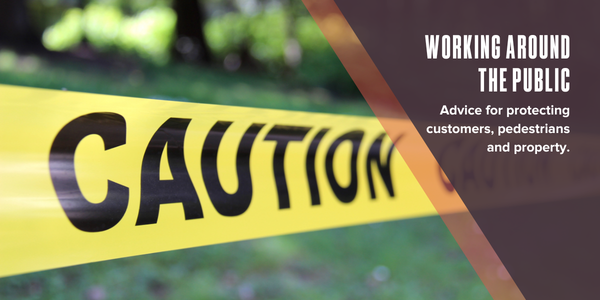
Working around the public
By Cotney Consulting Group.
Advice for protecting customers, pedestrians and property.
Outdoor contractors rarely work in isolation. They work around homeowners, tenants, students, athletes, pedestrians, delivery drivers and other trades. That means the worksite is not always fully under the crew's control, and protecting the public must be part of the job plan from the beginning. Landscaping crews operate at occupied homes and commercial properties. Pool and spa contractors work around families, guests and service personnel. Hardscape and outdoor living crews may share access with homeowners, tenants and delivery drivers. Sports-surface contractors often work near athletes, students and spectators. Maintenance teams may perform repairs while facilities remain open.
Customers may walk through an active work zone. Children may be curious about equipment. Pedestrians may ignore signs. Vehicles may enter unexpectedly. Pets may get loose. Other contractors may create new hazards without understanding how their work affects the site.
Protecting the public requires more than placing a few cones around the project. It requires planning access, controlling movement, communicating clearly and recognizing that people outside the trade may not understand hazards that seem obvious to experienced workers.
The public does not see the jobsite the way the crew does
Workers become familiar with open trenches, stored materials, cords, hoses, tools and equipment movement. Customers and pedestrians do not. A homeowner may step across an extension cord without realizing it could move. A child may climb on stacked material. A customer may walk behind a skid steer because they assume the operator can see them. Someone may enter a freshly coated area because the surface looks dry.
The public often sees a property, not a construction zone. That difference matters. Contractors must assume that customers, visitors and pedestrians may not recognize hazards unless those hazards are clearly controlled. A warning given once at the start of the job is not enough. Conditions change, and the people entering the area may change as well.
Define the work zone before work begins
Every project should have a clearly defined work zone. Work-zone boundaries should be based on where hazards can travel, not only where the crew is standing. Equipment movement, falling materials, dust, chemical drift, cutting debris and delivery traffic may all extend the danger well beyond the immediate work area.
The boundaries should reflect the actual hazards. Equipment travel paths, material staging, cutting areas, chemical handling and delivery access may all need to be included. Cones and caution tape may be sufficient for a short-duration, low-risk task. Larger or longer projects may require temporary fencing, barricades, gates or controlled access points.
The contractor should also identify which areas must remain open for the customer. That may include entrances, sidewalks, parking spaces, emergency exits or access to other parts of the property. Whenever possible, the public route should be separated from the work route. Asking customers to weave through materials and equipment is not a safe access plan.
Control equipment movement
Moving equipment creates one of the greatest risks to customers and pedestrians. Skid steers, loaders, utility vehicles, trailers, mowers and delivery trucks may operate in areas where the public is accustomed to walking or driving. Operators may have limited visibility, especially when carrying loads or using attachments.
Equipment routes should be established before movement begins. A spotter may be necessary where visibility is restricted, or public traffic cannot be fully excluded. Workers should never assume that a pedestrian will stop or move out of the way. People may be distracted, wearing headphones or focused on reaching an entrance.
Where public traffic cannot be separated from equipment movement, operations should pause until the route is controlled. The safer approach is to stop equipment movement, establish eye contact and confirm that the path is clear before proceeding. Whenever possible, deliveries and heavy equipment operations should be scheduled during lower-traffic periods.
Children require additional protection
Children may be attracted to equipment, open excavations, water features and stacks of material. They may also enter the work zone quickly and without warning. A verbal instruction to a parent does not replace physical controls. Open trenches, chemical containers, power tools and equipment should never be left accessible. Materials that can shift, roll or be climbed on should be secured. Keys should be removed from equipment, and controls should be protected against unauthorized use.
Crews working at homes, schools, parks and recreational facilities should remain especially alert during arrival, dismissal and play periods. If children or unauthorized personnel cannot be kept out of the work area, the affected task should be stopped until access is controlled. The contractor’s responsibility does not end simply because someone entered an area they were told to avoid.
Pets can create unexpected hazards
Dogs and other pets may behave unpredictably around noise, strangers and equipment. A pet may run into the path of a machine, pull a customer into the work zone or distract a worker using a tool. Open gates and temporary fencing may also allow animals to escape the property.
Before work begins, contractors should ask customers to secure pets away from the work area. The expectation should be clear and documented when necessary. Workers should not assume that a friendly animal will remain calm around saws, compactors, delivery vehicles or unfamiliar crews. Pet control protects the animal, the customer and the workforce.
Maintain safe access to occupied buildings
Work around occupied homes and facilities often affects entrances, sidewalks, stairs and parking areas. Contractors should identify how occupants will safely enter and exit throughout the project. Temporary routes should be stable, well-lit and free of tools, cords, hoses and loose materials.
Temporary routes should also preserve accessibility for people with mobility limitations whenever the project affects an existing accessible path. Emergency exits, fire department access and accessible routes should not be blocked without an approved alternate plan. If an entrance must close temporarily, the contractor should clearly communicate the change and provide a safe alternative route. A handwritten sign placed after access is blocked is not enough. Occupants need to know about changes before they encounter them.
Secure tools and materials
Customers and pedestrians should never be exposed to unsecured tools, sharp materials or unstable storage. Blades should be retracted or covered. Power tools should be disconnected or secured when unattended. Chemicals should remain closed, labeled and inaccessible to unauthorized people. Lumber, pipe, pavers, stone, fixtures and other materials should be stacked so they cannot roll, slide or fall. Lightweight materials should be protected from wind.
Waste also requires attention. Broken tile, wire ends, nails, packaging straps and sharp offcuts can injure anyone who enters the area. The work zone should remain under control during breaks, overnight and whenever the crew leaves the property. An unattended jobsite still belongs to the contractor.
Coordinate with property management and other trades
On commercial, multifamily and public projects, several groups may control access and communication. Property managers, facility staff, security personnel and other contractors need to understand the work schedule, restricted areas and changing hazards.
A short coordination meeting can prevent conflicting deliveries, blocked routes and overlapping work. It can also establish who will notify tenants, visitors or employees about access changes. Every contractor should communicate the hazards created by their own work. They should not assume the general contractor or property manager has informed everyone. When responsibilities are unclear, the public is usually the one left navigating the confusion.
Use signs that people can understand
Signs should identify the hazard and tell people what action to take. A generic “Caution” sign may not indicate whether the danger involves an open trench, wet coating, chemical application, overhead work or moving equipment. Whenever practical, signage should identify the condition and the required response. That may include directing pedestrians to another entrance, warning that a surface is wet or restricting access during equipment movement.
Signs should be placed where people have enough time to respond. A warning positioned directly beside the hazard may be too late. Language differences should also be considered. Symbols, multiple languages or direct verbal communication may be necessary depending on the location. A sign is only useful when the person seeing it understands what to do.
Manage noise, dust and debris
Protecting the public also means controlling exposures created by the work. Cutting, grinding, blowing, spraying and demolition can produce dust, debris and noise that travel beyond the work zone. Open windows, air intakes, nearby vehicles and neighboring properties may be affected.
Contractors should plan where cutting and material preparation will occur. Dust controls, barriers or temporary shutdowns may be needed. Blowers should not direct debris toward pedestrians, traffic or occupied areas.Cutting, grinding or blowing should stop when controls are not keeping debris within the work area.
Customers should receive advance notice when work will create significant noise or temporary access restrictions. Professional contractors do not simply complete the task. They manage how that task affects everyone around it.
Respond to changing conditions
Public-protection plans need to change as the project changes. A delivery may block the normal walkway. Rain may create mud on the temporary route. A trench may move into a new area. Another contractor may remove a barricade or open a gate.
Supervisors should inspect public-access controls throughout the day. Damaged signs, displaced cones and open barriers should be corrected immediately. Workers should also be encouraged to report any instances in which customers or pedestrians enter unsafe areas. The plan is only effective when it reflects current conditions.
Document public-safety controls
Documentation protects both the public and the contractor. Daily reports and photographs can show how work zones, access routes and barricades were established. Records should note significant changes, customer notifications and any incidents or near-misses involving the public.
If a customer refuses to comply with access restrictions or repeatedly enters the work zone, it should be documented and addressed with the project contact. Documentation should support the controls in place, not substitute for them. It also gives the company information it can use to improve future planning.
Public safety reflects the contractor’s professionalism
Customers may not understand every technical detail of the work, but they notice how the jobsite is managed. They see whether walkways remain open, whether crews communicate and whether tools and materials are controlled. They remember whether workers treated their property and family members with respect.
A contractor who protects the public reduces injury risk, avoids disruption and strengthens customer confidence. Public safety is part of professional jobsite management. Contractors who define work zones, control equipment movement, maintain safe access and communicate changing conditions protect their customers, their crews and the reputation their businesses depend on.
Learn more about Cotney Consulting Group in their Coffee Shop Directory or visit www.cotneyconsulting.com.
Recommended For You
Heat, hydration and fatigue
Read More ...
Handle with care
Read More ...
Hazard awareness: Building a worker’s ability to see problems before they happen
Read More ...
UP TO THE MINUTE






Comments
Leave a Reply
Have an account? Login to leave a comment!
Sign In