




The hidden strain
By John Kenney, Cotney Consulting Group.
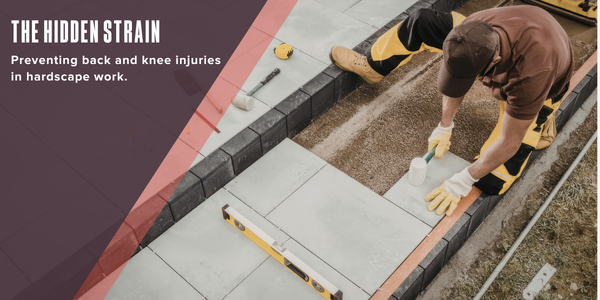
Preventing back and knee injuries in hardscape work.
Hardscape work demands skill, strength and precision. Every day, crews lift stone, carry pavers, kneel on rigid surfaces and maneuver awkward loads into place. It’s some of the most physically demanding work in the outdoor living industry — and because of that, chronic back and knee injuries are far more common than most contractors realize.
You don’t always see these injuries happen. They develop quietly over months and years. A worker kneels too long on a slab, twists while lifting a paver or spends an entire shift bending over in the same pattern. By the time the pain shows up, it’s often too late. And when an experienced installer goes down with an injury, productivity suffers, projects slowand companies lose the skill and craftsmanship that keep their reputations strong.
What the job does to the body
Hardscape crews spend much of their day in positions the human body wasn’t designed to maintain: bent over, kneeling, lifting, carrying and pivoting with weight. Unlike a single, sudden incident, these strains build up over time. A paver only weighs 20–30 pounds, but lifting hundreds of them in a day places continuous stress on the spine and joints.
Knee pain is widespread. Extended kneeling on stone or compacted soil compresses the knee joint, inflames soft tissues and irritates existing injuries. Add in uneven terrain and constant up-down movement and you have a perfect recipe for long-term joint damage.
Back injuries often follow the same predictable pattern. Workers pick up materials with rounded backs, twist while carrying loads or lift from awkward angles because the staging area wasn’t set correctly. Even the strongest worker can only do that for so long before something gives.
Prevention starts with better planning
Preventing strain doesn’t begin with equipment — it starts with job setup. If materials are staged too far from the work zone, crews will naturally lift and carry more than they should.By reducing unnecessary movement, you relieve excessive stress.
Before work begins, foremen should evaluate:
- Where pallets will be placed for the least manual handling
- How tools and materials will flow through the job
- Whether mechanical aids like carts, dollies or vacuum lifters can reduce repetitive lifting
- How terrain affects footing and knee load
Hardscape work requires planning for both layout and ergonomics. Ignoring one undermines the other.
Teach crews the right way to lift
Proper lifting is still one of the most effective ways to prevent back injuries. Train your crews to:
- Bend at the knees, not the waist
- Keep the load close to the body
- Use both hands and avoid one-sided lifting
- Step, don’t twist, when changing direction
- Ask for help with oversized materials
It sounds basic, but on busy jobsites, basic safety is often the first thing sacrificed. Reinforcement from foremen and lead installers is key. When supervisors model the right behaviors, crews follow their lead.
Protect the knees — The crew’s most valuable tools
Knee injuries sideline more hardscape workers than almost any other musculoskeletal issue. The fix isn’t complicated, but it requires consistency.
Use:
- Padded knee protection (hard-shell pads, gel pads or cushioned supports)
- Kneeling boards or mats to distribute pressure on stone surfaces
- Frequent position changes to avoid long-term compression
- Rotation of tasks so workers aren’t kneeling all day
Crews often resist knee pads because they’re uncomfortable or feel restrictive. Modern pads are far better than what we had 20 years ago. The right equipment makes a difference — and so does regular replacement.
Mechanical assistance isn’t optional anymore
Hardscape materials are heavier and larger than ever. Large-format pavers, oversized slabs and stone veneer panels require mechanical assistance. Too many contractors rely on “strong backs” instead of innovative tools.
Lift-assist devices, vacuum lifters and powered carriers dramatically reduce strain. More importantly, they improve accuracy and minimize material breakage. When companies invest in ergonomic equipment, they invest in their people — and their production.
Build a culture that doesn’t ignore pain
Workers often hide discomfort to avoid slowing the crew, but pain is an early warning sign. Encourage installers to speak up before a minor strain becomes a serious injury. Create an environment where asking for help or using a mechanical aid isn’t seen as a weakness but as a sign of professionalism.
A crew that feels valued takes better care of themselves, their tools and the job.
A strong crew starts with strong practices
Hardscape contractors depend on the skill and experience of their crews to deliver high-quality, long-lasting installations. Protecting back and knee health isn’t just a safety issue — it’s a business issue. Less fatigue means better workmanship. Fewer injuries mean more consistent staffing. And a company known for looking out for its people is a company workerswant to build a career with.
The longevity of your team is one of your most important assets. When you prioritize ergonomic practices, you protect the craft, the crew and the future of your business.
Learn more about Cotney Consulting Group in their Coffee Shop Directory or visit www.cotneyconsulting.com.
Recommended For You
Walking-working surfaces: The everyday hazards that put crews at risk
Read More ...
Worn tires, real risks: Why contractors can't afford to ignore tire safety
Read More ...
Heat, hydration and fatigue
Read More ...
UP TO THE MINUTE




Comments
Leave a Reply
Have an account? Login to leave a comment!
Sign In